
Services
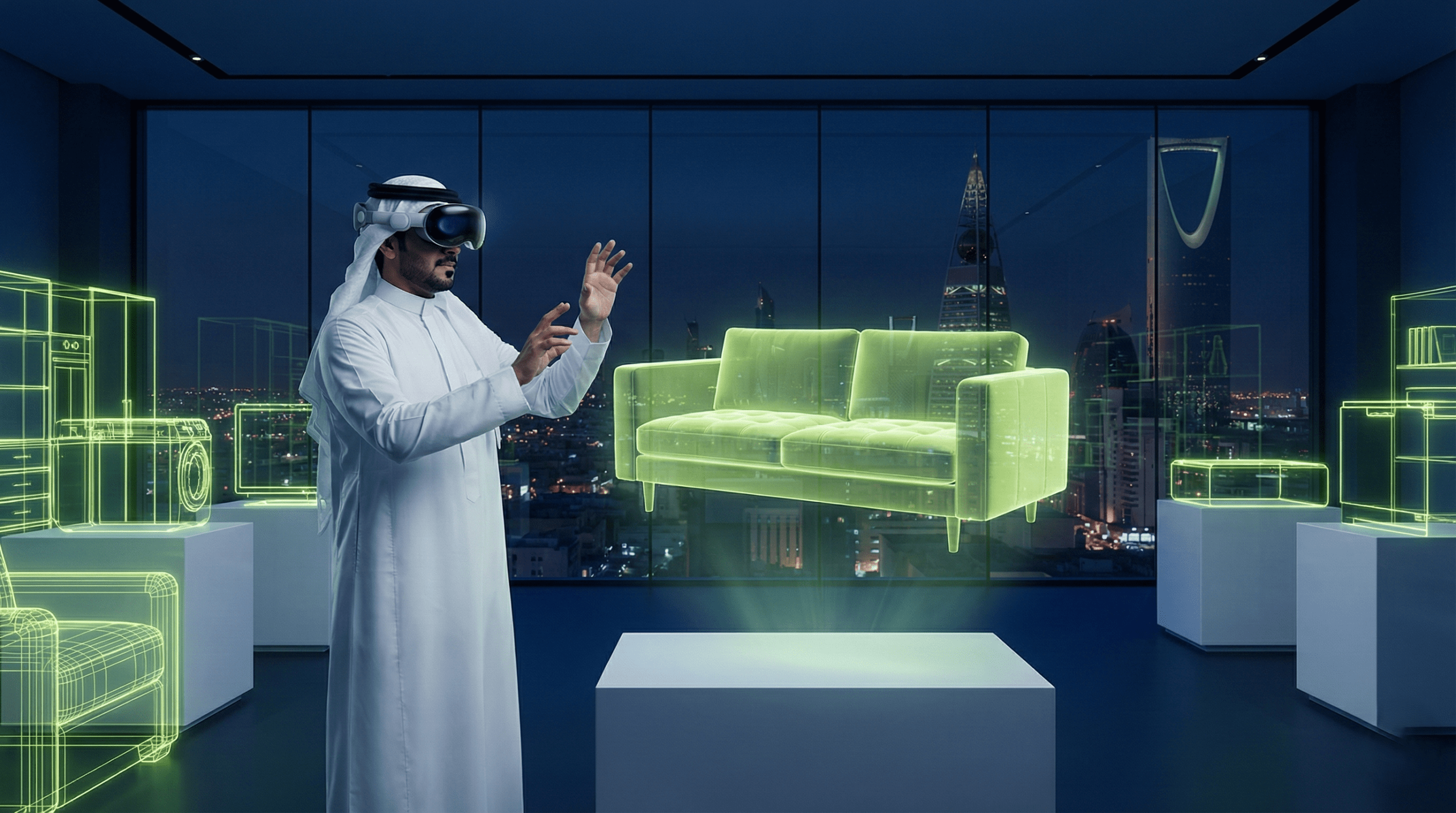
Have you imagined your customer entering your store while you sleep? Are you still relying on static images while your competitors move toward VR virtual stores?
Indeed, this is the qualitative leap the Kingdom is witnessing today. VR virtual stores are the new generation of the future of shopping in Saudi Arabia, offering a three-dimensional environment that allows the customer to interact with and fully experience products through virtual reality and augmented reality (VR AR). This shift not only enhances the customer experience but represents a real competitive advantage for ambitious brands in the Saudi market seeking to overcome the biggest challenge: offering a traditional shopping experience that doesn’t set them apart.
The Saudi customer has become more curious and eager for unique experiences. The traditional two-dimensional (2D) store is no longer able to meet this ambition; rather, it causes the brand to lose its distinction.
You are about to learn:
At first glance, VR virtual stores may seem a complex concept, but at its core it is simple: it is your online store, but in a three-dimensional (3D) world. Instead of scrolling through the store’s pages, the customer walks around inside a digital environment that simulates your actual store, giving them a sensory and emotional experience that traditional sites cannot provide.
It is very important to understand the difference between the two technologies, because both are used in building VR virtual stores and Saudi virtual stores:
The practical application in stores: You might use a full VR store for customers equipped with headsets, while using a simple AR feature in your current store (on mobile) to enable the customer to “try the product” in their space.
True convenience comes from intelligence; discover how integrating e-commerce with artificial intelligence technologies in personalizing the buying journey for each customer.
The traditional two-dimensional store leaves a wide margin for doubt and uncertainty; is the product large? Is the fabric soft? Is the color a match? VR virtual stores come to solve these “pain points”.
4 key benefits of the sensory experience (VR AR):
The Kingdom leads, thanks to its strong digital infrastructure and Vision 2030’s support for digital transformation, in adopting these technologies. Saudi virtual stores is already achieving notable successes in specific sectors that rely heavily on appearance and the visual experience.
The furniture sector is the biggest beneficiary of augmented reality (AR) technology. Imagine your customer seeing the dining table they liked in your store already placed in their home’s living room before they buy it.
The virtual experience generates massive data; discover the importance of data analytics for small and medium businesses to turn customer interactions into winning decisions
Shopping for clothes is no longer just viewing images on fashion models. Now, you can build three-dimensional virtual showrooms (Virtual Showrooms) in a virtual reality environment that allows the customer to:
Realism requires acknowledging that the transition to VR AR is not free of challenges, but they are solvable by relying on technical experts:
| Comparison between a traditional 2D store and a virtual VR store | The two-dimensional store (2D) | The virtual store (VR) |
| Product visualization | Limited (static images and videos) | Integrated (360 degrees, real size, AR experience) |
| Cost of returns | High (due to mismatched expectations) | Very low (the customer tried the product virtually) |
| Average order value | Medium | High (the purchase is made with greater confidence) |
| Customer immersion time | Low (5-10 minutes) | High (30 minutes or more in VR environments) |
Note: According to a report issued by IDC, the market for virtual reality and augmented reality solutions in the Middle East is expected to grow at compound annual rates exceeding 45% A report or statistic on the growth of the virtual reality market in the Middle East region
The transition to the world of VR virtual stores is not done at the push of a button, but requires careful planning and advanced technical integration. If you are an ambitious Saudi entrepreneur, these are the essential steps you must focus on:
This is the cornerstone of your virtual store. If the 3D content is inaccurate or of poor quality, the entire the customer experience will fail.
To ensure a smooth purchasing process in this the future of shopping , your virtual store must speak fluently with your business management system and local payment gateways.
In the virtual environment, the metrics of success change. “Click-through rate” is no longer the only metric; instead, you must focus on:
5 essential features in a virtual reality store:

You have discovered that VR virtual stores is not just a fad, but a business strategy to enhance the customer experience and establish an unrivaled competitive advantage in the the future of shopping Saudi market. This is your investment in the brand’s distinction.
But the transition to virtual reality and VR AR requires deep expertise in designing 3D models, developing custom applications, and integrating with payment and management systems (Odoo). This is a major challenge that wastes the entrepreneur’s time and effort, and can lead to a poor experience that fails to achieve the required differentiation.
Don’t lose the advantage of your customers’ curiosity and desire to experience. Bateel Tech is your specialized partner in the solutions of Saudi virtual stores. Our team offers you a free consultation, and then handles building your virtual store entirely, from designing professional 3D models to launching an integrated, seamless VR AR experience that complies with all the requirements of the Saudi market, so that you ensure you outperform your competitors and attract the new generation of shoppers.
Are you ready to cross over into the future of shopping? Request your free consultation today to start designing a virtual reality store of your own with Bateel Tech.
Bateel Tech’s augmented and virtual reality (VR / AR) solutions service page
The decision to adopt VR virtual stores is a strategic decision that places your brand at the forefront of the future of shopping. The technologies of VR AR do not offer mere entertainment, but provide solutions to reduce returns and increase engagement. Always remember that secure technical integration, especially with local payment solutions, is the key to success in Saudi virtual stores. Don’t wait until virtual reality becomes the standard; start now to be the leader who creates the future of shopping in the Kingdom.
The time depends on the complexity of the 3D models and the number of products. The initial development of a simple AR experience may take a month, while an integrated virtual reality store may take from 3 to 6 months to ensure the best customer experience.
The initial cost is higher than a traditional store, but the return on investment is very high due to the distinction and competitive advantage. You can start with a simple AR experience (displaying a single product) as your gateway to the future of shopping with VR AR technology at a lower initial cost.
Answer: Not necessarily. A simple AR experience can be provided via the camera of any smartphone. The full virtual reality (VR) experience, however, requires dedicated headsets (such as Meta Quest), but it offers the highest level of immersion in the customer experience.
Integration is done with secure and certified payment gateways (such as mada) via an application programming interface (API) that ensures the payment process takes place in a secure environment outside the virtual reality environment, guaranteeing high reliability for Saudi customers.
