
Services
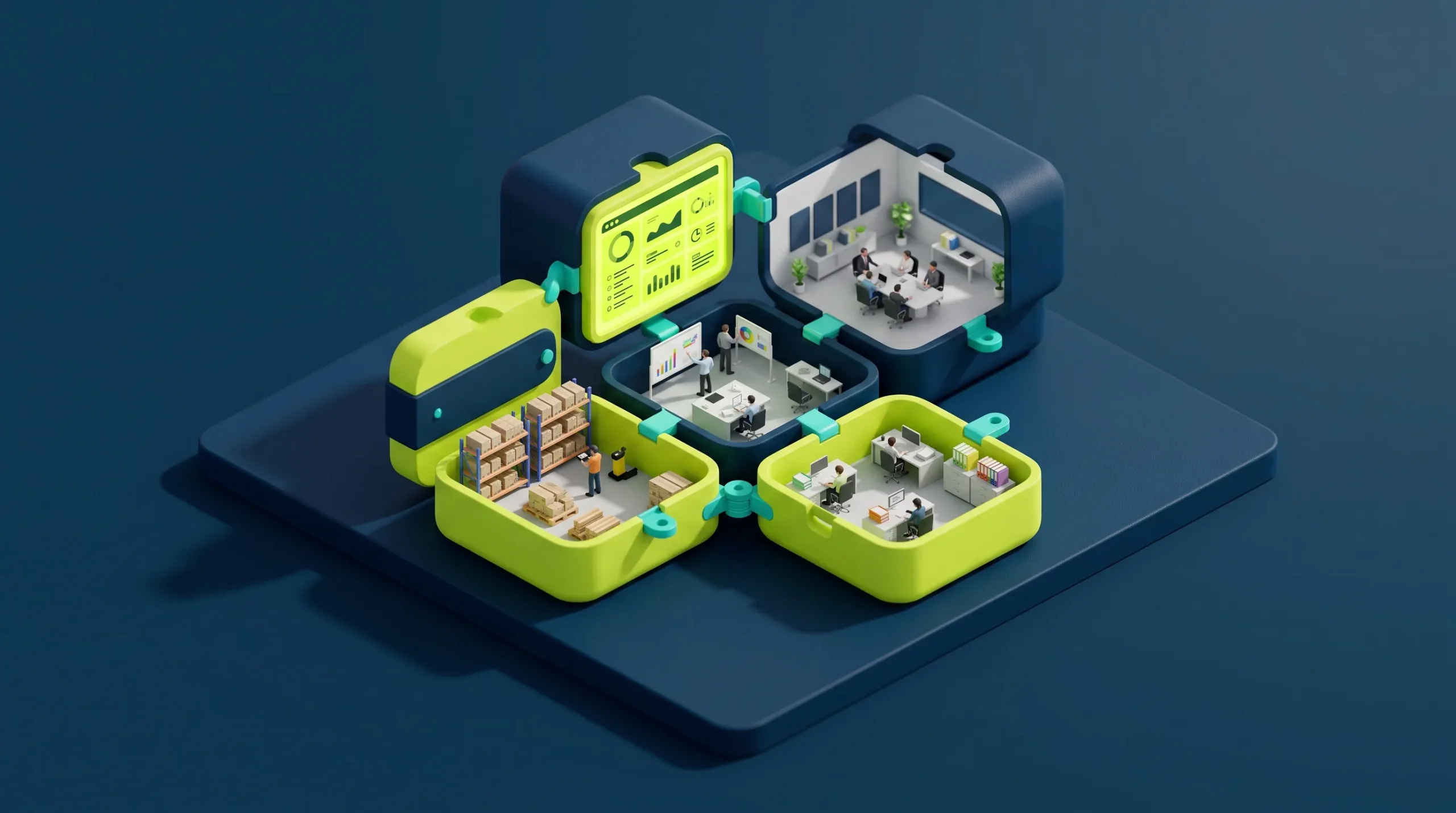
The Saudi business sector is undergoing an unprecedented digital transformation driven by Saudi Vision 2030, and Odoo (Odoo ERP) has become one of the most sought-after solutions for Saudi companies to manage their operations — from accounting and inventory to sales and human resources — on one integrated platform. And with the Zakat, Tax and Customs Authority (ZATCA) mandating e-invoicing (“Fatoora”), relying on Excel spreadsheets and scattered programs is no longer a practical or safe option. In this comprehensive 2026 guide, we explain what Odoo is, its core modules, its compliance with ZATCA requirements, its actual cost in Saudi riyals, how it compares with SAP and Microsoft Dynamics, and the step-by-step implementation process — along with the most common mistakes companies make when moving to ERP systems and how to avoid them from day one.
Odoo is an open-source enterprise resource planning (ERP) system that brings all of a company's departments together on one platform: accounting, sales, purchasing, inventory, human resources, customer relationship management, manufacturing, and even the website and store. Instead of using a separate accounting program, an Excel file for inventory, and a third app to track customers, Odoo gives you a single source of truth in which data flows automatically between departments; so when a sales rep issues an invoice, inventory, accounts, and financial reports all update at the very same moment.
The system began in 2005 in Belgium under the name TinyERP, then evolved into OpenERP before settling on the name Odoo in 2014. Today, Odoo has more than 12 million users worldwide, and its platform includes over 40 official apps and thousands of community add-ons. This wide adoption means continuous updates, rich documentation, and a network of certified implementation partners in most countries, including Saudi Arabia. In the Gulf specifically, Odoo adoption in Saudi Arabia has accelerated in recent years thanks to its flexibility in meeting local tax requirements and its lower cost compared with traditional global systems.
Odoo is available in two main editions:
We'll detail the financial differences between the two editions in Saudi riyals in the cost section later in this guide.
You may wonder: my company has run for years on a simple accounting program, so why switch to Odoo now? The answer lies in four shifts the Saudi market is currently experiencing.
Saudi Vision 2030 placed digital transformation at the heart of its economic strategy, and government entities and large corporations now require their suppliers and partners to meet a certain level of digitization and financial discipline. Companies that run their operations through a unified ERP system can present accurate financial statements, respond to regulators' requirements, and compete for major contracts with greater confidence.
The average mid-sized company in Saudi Arabia uses, on average, 4 to 7 separate programs: an accounting program, Excel sheets for inventory, WhatsApp to follow up with customers, and paper files for HR. The result? Conflicting data, repeated entry errors, and hours lost to manual reconciliation. Odoo eliminates this fragmentation; every department works on the same database, and every transaction is recorded only once.
Odoo's dashboards give you a real-time snapshot of your company's performance: daily sales, cash flow, receivables aging, inventory levels, and each sales rep's performance. Instead of waiting for a monthly report prepared by hand, the manager makes today's decision based on today's numbers.
One of Odoo's strongest advantages is that it grows with you; you can start with two or three modules (such as sales, accounting, and inventory), then add HR, manufacturing, or e-commerce later without changing the system or re-entering data. This flexibility makes it the preferred choice for small and medium companies planning to grow.
Although Odoo suits most business activities, some sectors in the Saudi market gain an exceptional return from it:
Odoo includes dozens of modules, but these are the six that form the backbone of most implementation projects in the Saudi market:
Odoo's accounting module supports the Saudi chart of accounts, the 15% value-added tax, the core financial reports (income statement, balance sheet, cash flows), tax returns, and automatic bank reconciliations. It also supports issuing e-invoices compliant with the Zakat, Tax and Customs Authority's requirements, which we detail in the next section. Thanks to its integration with the other modules, every sale, purchase, or payroll run is reflected in the books automatically without any double manual entry — meaning a faster monthly close and financial statements ready for the external auditor at any time.
Precise tracking of quantities across multiple warehouses, automatic minimum-reorder management, support for barcodes, serial numbers, and expiry dates, and periodic stocktaking without halting operations. It also calculates inventory cost by multiple methods (weighted average, FIFO) and links it directly to the financial statements. An ideal module for wholesalers, retailers, car showrooms, and distribution companies.
From the first contact with a lead to collecting the invoice: recording sales opportunities, sending professional quotations, following the negotiation stages, and converting a quote into a sales order and invoice with a single click. CRM can be linked to your ad campaigns to measure the return of each marketing channel; and if you want to activate this integration professionally, see the Odoo ERP development service from Bateel Tech to turn Odoo data into smarter campaigns.
Employee files, leave, attendance, and payroll with calculation of allowances and social insurance (GOSI) contributions, performance reviews, and job applications. The HR module saves your company dozens of administrative hours each month and minimizes payroll errors, with a complete digital archive of employees' contracts and documents that eases compliance with Saudi labor regulations.
For Saudi factories and workshops, the manufacturing module provides bills of materials (BOM), manufacturing orders, capacity planning, and calculation of the product's actual cost including materials and labor. Its direct integration with inventory and purchasing means any raw-material shortage is detected before the production line stops, not after.
Odoo lets you build an online store linked directly to inventory and accounting, plus a point-of-sale (POS) system for branches that works even when the internet is down. And if you plan to launch a professional store with a strong brand identity and a complete local buying experience, Bateel Tech builds it on Odoo modules as part of the Odoo ERP development service with full integration to inventory, accounting, and Saudi payment gateways.
This point in particular is what makes choosing an ERP system in Saudi Arabia different from any other market. The Zakat, Tax and Customs Authority has mandated that all establishments subject to VAT adopt e-invoicing (“Fatoora”) in two phases:
It began in December 2021 and requires issuing invoices electronically (not on paper or in editable formats) with mandatory elements such as a QR Code on simplified tax invoices. Odoo supports these requirements natively within its Saudi localization, with no need for external customization.
It began in January 2023 in waves based on revenue size, and requires linking the establishment's invoicing system directly to the Authority's “Fatoora” platform, issuing invoices in the approved XML format, with the cryptographic stamp and the unified serial number (UUID). Recent versions of Odoo provide a direct link to the Authority's platform, so the invoice is cleared (Clearance) or reported (Reporting) automatically the moment it's issued from the system.
Odoo fully supports Arabic in interfaces, reports, and invoices with correct RTL direction, and allows issuing bilingual (Arabic/English) invoices as the Authority requires, in addition to supporting the Hijri calendar in the modules that need it. But note: correctly enabling these requirements needs an implementation partner who knows the details of Saudi regulations, as a wrong configuration could expose your establishment to Authority fines.
The takeaway here matters for any Saudi establishment: when comparing ERP systems, don't only ask “does the system support e-invoicing?” — ask “has the partner who will implement it actually carried out the integration with the Fatoora platform before?” The difference between theoretical support and real implementation experience is what determines how smoothly your invoices are cleared from day one.
Are you ready to run your company on Odoo ERP?
Get a free assessment of your company's needs from Bateel Tech's Odoo specialist team.
When searching for an ERP system in Saudi Arabia, you'll find three names come up constantly: Odoo, SAP, and Microsoft Dynamics 365. Each has its rightful place in the market, and the wrong choice here means either paying several times what you actually need, or hitting a system that can't keep up with your company's growth after two years. The following table summarizes the fundamental differences between the three systems from the perspective of Saudi companies:
| Comparison aspect | Odoo | SAP | Microsoft Dynamics 365 |
|---|---|---|---|
| Target Segment | Small, medium, and growing companies | Enterprise giants and government institutions | Medium and large companies |
| Estimated cost to start | From SAR 15,000 (a free edition is available) | Often exceeds SAR 500,000 | From roughly SAR 150,000 |
| Implementation time | From one month to 6 months | From 9 months to two years | From 4 to 12 months |
| Flexibility and customization | Very high (open source) | High, but costly and complex | Medium to high |
| Arabic support and Saudi invoicing | Built-in, with full Saudi localization | Available through specialized partners | Available through specialized partners |
| Ease of use | A modern, easy-to-learn interface | A long learning curve | Familiar to Microsoft users |
If your company is small or medium (roughly 5 to 250 employees), and you want a comprehensive system implemented within a few months on a reasonable budget that grows with you module by module, then Odoo is the most logical choice in the Saudi market today. This is why Odoo is considered the best ERP system for small and medium companies in terms of value-to-cost ratio.
If you're an enterprise giant with thousands of employees and complex operations across several countries, needing strict governance and globally unified processes with a budget in the millions of riyals, then SAP may be the better fit. Dynamics, meanwhile, stands out when your company's tech stack is fundamentally built on the Microsoft ecosystem (Azure and Microsoft 365) and you want native integration with it.
The most important question for any business owner: how much will Odoo actually cost me? The total cost consists of three elements: licensing, implementation and customization, then hosting and annual support.
| Comparison aspect | Odoo Community | Odoo Enterprise |
|---|---|---|
| License fees | Completely free | A monthly per-user subscription |
| Available modules | The core modules | All modules, including full accounting and payroll |
| Hosting | Self-hosted (your server or your partner's server) | Odoo's official cloud, Odoo.sh, or self-hosting |
| Support and updates | Via the community or the implementation partner | Official support and guaranteed upgrades between versions |
| Best suited for whom? | Startups and small companies on a limited budget | Companies that need integrated accounting and payroll and reliable support |
This is the largest part of the investment, and it depends on the number of modules, the volume of migrated data, and the extent of customization required. The estimated ranges in the Saudi market for 2026:
These are indicative figures, and the exact cost is determined after a needs-analysis session; just as the cost of websites varies by requirements, as we explained in our guide on website design cost in Saudi Arabia 2026.
Cloud hosting ranges from SAR 3,000 to 15,000 per year depending on data volume and number of users, while annual support and maintenance contracts usually range between 10% and 20% of the implementation project's value. Beware of overlooking this item when budgeting; a system without ongoing support ages and loses its compatibility with the Authority's updates.
Most Saudi companies that have implemented Odoo recover their investment within 12 to 24 months through: reducing manual administrative work hours by up to 40%, cutting inventory and invoicing errors, faster collection of receivables thanks to automated follow-up, and sharper purchasing and pricing decisions thanks to real-time reports.
The success of an ERP project doesn't depend on the software alone, but on the implementation methodology. Global statistics show that a large share of ERP projects exceed their budget or timeline due to poor planning, not the system itself. These are the six phases we follow at Bateel Tech with our clients to ensure a smooth transition:
Working sessions with decision-makers and department heads to document the current workflow, identify pain points, and set priorities. The output of this phase is a clear scope document that defines the required modules and success metrics.
Based on the analysis, we determine whether the Community edition is enough or you need Enterprise, and which modules launch in the first phase, with a realistic timeline. The golden rule: start with the core modules (accounting, sales, inventory), then expand gradually.
Configuring the Saudi chart of accounts and taxes, setting up e-invoicing and the link with the “Fatoora” platform, building the required customizations (print templates, additional fields, custom reports), and connecting the system to your website or online store if you have one.
Moving account balances, customer and supplier data, and inventory items from your legacy systems after cleaning them of duplicates and errors. The quality of your data at go-live determines your team's confidence in the new system.
Hands-on training in Arabic for each department on its daily screens, with a parallel pilot period to confirm the results match before full adoption.
The official switch to the system with intensive support in the first weeks, then periodic reviews to improve usage and add new modules as your business grows.
From our experience with Saudi companies, these six mistakes are the number-one reason ERP projects stall:
The common thread across all these mistakes is treating Odoo as a purely technical project, when at its core it's a business-development project in which management and employees take part. Companies that appoint an internal project owner, set measurable goals before starting, and commit to gradual implementation phases reach tangible results within the first quarter of operation.
Having a capable local implementation partner is the decisive factor between a successful project and a stalled one. When evaluating any Odoo company in Saudi Arabia, ask about:
At Bateel Tech Solutions we provide Odoo implementation from Riyadh to our clients across all regions of the Kingdom: analysis, implementation, training in Arabic, and ongoing support, with full configuration of the Zakat, Tax and Customs Authority's requirements.
Yes, Odoo supports Arabic in interfaces, reports, and invoices with correct RTL direction, and you can issue bilingual (Arabic/English) invoices as the Zakat, Tax and Customs Authority requires, in addition to Hijri calendar support.
Yes, recent versions of Odoo support the requirements of both Phase One and Phase Two, including the QR code, the approved XML format, and the direct link with the Authority's platform. What matters is that the configuration is handled by an implementation partner well-versed in Saudi regulations to ensure invoices are cleared correctly.
Small-company projects (5–10 users with three to four modules) start at around SAR 15,000 to 50,000 including implementation and training, plus Enterprise licenses if chosen (around SAR 90–140 per user per month), while the Community edition is entirely license-free.
For small companies, usually one to three months, and for medium companies three to six months, depending on the number of modules, the extent of customization, and data readiness. Starting with the core modules and then expanding gradually shortens the timeline and raises the success rate.
The Community edition is free and open source with core modules and requires managing hosting yourself, while Enterprise is a paid per-user subscription that adds full accounting, payroll, advanced manufacturing, official support, cloud hosting, and the mobile app. Choosing the right edition depends on the scale of your operations and the modules you actually need.
Today, Odoo has become the shortest path for Saudi companies toward unified digital management that is compliant with local regulations — from e-invoicing to payroll and inventory. Whether you're a startup looking for an economical start with the Community edition, or a mid-sized establishment that needs an integrated Enterprise ecosystem, the real difference between a project that earns its return within a year and one that stalls halfway is the quality of planning and the expertise of the local implementation partner.
Bateel Tech Solutions' team in Riyadh is ready to study your company's needs and provide a free Odoo consultation covering an assessment of your current situation, the recommended modules, and a realistic estimate of the cost and timeline. Contact us now via WhatsApp or through Contact Us Page, and begin your digital transformation with a confident first step.
