
Services
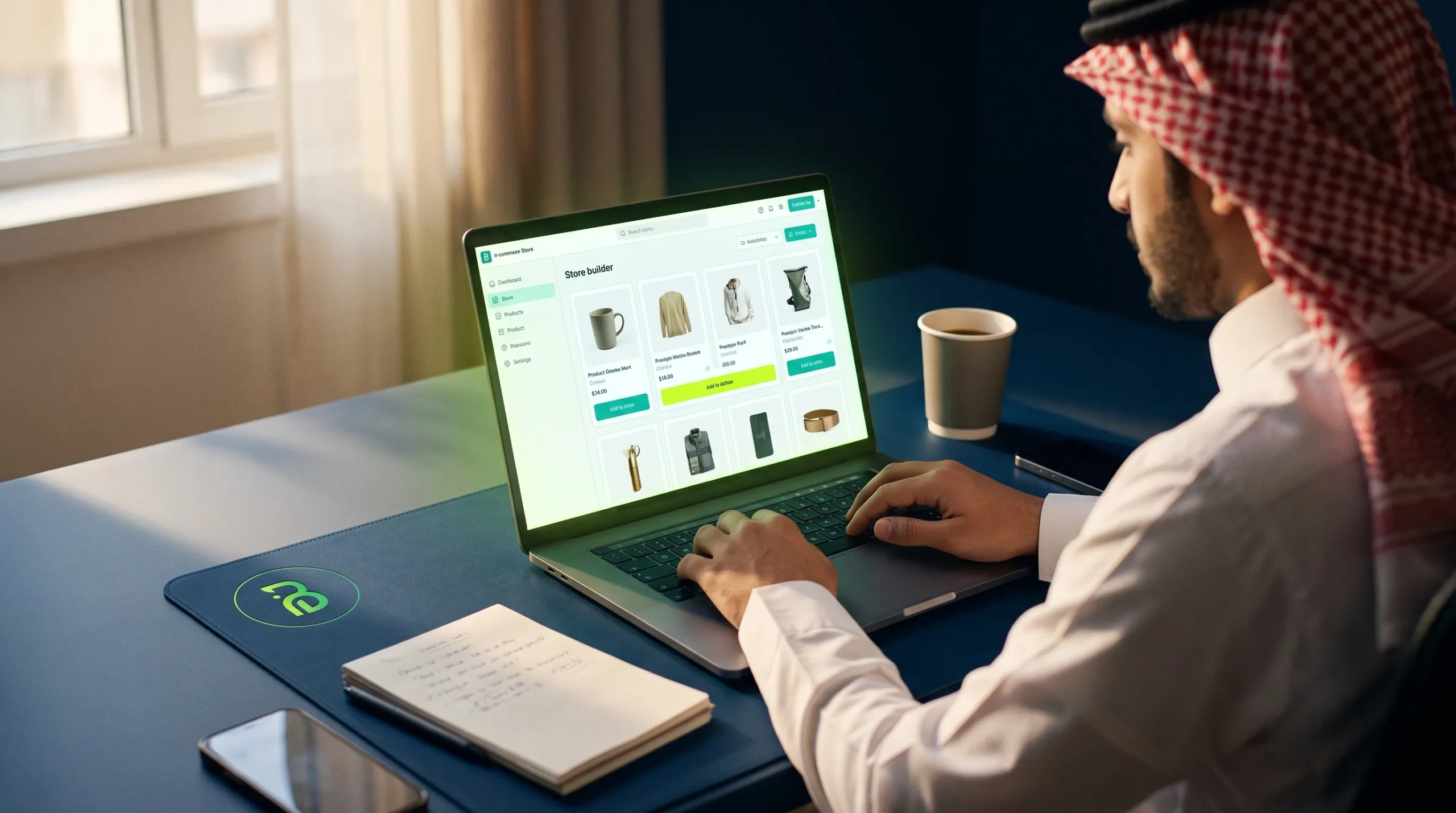
If you are thinking of starting an online store in Saudi Arabia, you are looking at one of the best investment opportunities in the region today: an e-commerce market worth tens of billions of riyals a year, Saudi consumers who are used to buying online and paying digitally, and a mature government and logistics infrastructure that supports new merchants as part of the Vision 2030 targets. But the difference between a store that generates real sales and one that closes after a few months is not luck; it is organized, step-by-step execution. In this practical guide, we take you through the steps of building a successful online store from scratch: from market research and choosing a niche, through the legal requirements, choosing a platform, brand identity and design, and setting up payments and shipping, all the way to launch and your first marketing push, with a timeline, an estimated budget in Saudi riyals and the most common beginner mistakes to avoid from day one.
Before getting into the steps, it is important to understand the size of the opportunity you are stepping into. Saudi e-commerce is growing at some of the highest rates in the region, driven by structural rather than seasonal factors: internet and smartphone penetration among the highest in the world, a young generation that makes up the majority of the population and prefers buying digitally, a mature electronic payment ecosystem led by mada, Apple Pay and digital wallets, and shipping and delivery networks that cover the Kingdom's cities within a few days.
On top of that, the state itself is a supportive party: the E-Commerce Law and the Maroof platform have raised consumer confidence in buying from verified stores, and the government procedures for issuing a commercial registration are now fully online and completed within minutes. Most importantly, the tools for building stores, from ready-made Saudi platforms to custom solutions, are now within everyone's reach at costs starting from a few thousand riyals. In short, the technical and regulatory barriers that made opening an online store difficult a few years ago have dropped to their lowest levels, while demand keeps expanding. Whoever enters the market today with sound planning builds their share before competition intensifies further.
This is the complete roadmap we will detail in this guide. Keep it in front of you, because each step builds on the one before it, and skipping any of them is the number one reason new stores stumble:
The decision that most determines your store's fate is made before you design a single line: what will you sell? Beginners choose the product they "like", while successful merchants choose the intersection of three circles: real demand in the Saudi market, competition that can be broken into, and a profit margin that can absorb advertising and shipping costs. Start with free tools: Google Trends to measure demand trends for product categories in Saudi Arabia, the search results themselves to track competing stores, their prices and their ratings, and social media accounts to understand customers' complaints about competitors. Every recurring complaint is a gap you can fill.
Next, define your ideal customer more precisely than "everyone": their age, city, approximate income, the platform they spend their time on, and the problem your product solves for them. This is not a theoretical exercise; it is what will later guide your choice of ad platform, the tone of your content and even the design of the store itself. One of the smartest ways to validate before investing: offer the product for pre-sale through a simple social media account or a landing page. If you get real orders, the market has validated your idea at the lowest possible cost before you begin the full journey of building an online store.
The golden rule for beginners: a specific niche beats a general market. An "everything" store needs huge budgets to compete with the major platforms, while a store specialized in a clear category (specialty coffee supplies, men's grooming products, travel and camping gear, organic children's clothing) builds a loyal audience on a reasonable budget and becomes a reference name in its category. Also check your profit margin early: a product that sells for less than SAR 50 can hardly absorb shipping and advertising costs, so many experts prefer to start with products priced between SAR 100 and 500 with a margin of at least 40%.
Operating legally is not a luxury: it is a condition for contracting with payment gateways and major shipping companies, and a decisive trust factor for Saudi consumers. The practical summary comes down to three points. First, obtain a commercial registration with e-commerce as the activity through the Ministry of Commerce platforms and the Saudi Business Center; the process is fully online and may be completed the same day. Second, verify your store on the Maroof platform so it gets the government trust seal that shoppers check before buying. Third, know where you stand on value added tax: registration is mandatory only once your annual taxable revenue exceeds SAR 375,000, and it brings e-invoicing obligations in line with the requirements of the Zakat, Tax and Customs Authority (ZATCA).
This is a condensed summary that is enough to get you started, but the full details (types of legal entity, steps to issue the registration, government costs, consumer rights and return policies) are covered in a separate guide we recommend reading before you begin: Requirements for opening an online store in Saudi Arabia: the complete legal guide.
Your store platform is the ground on which you will build everything, and changing it later is costly and exhausting, so choose carefully from the start. There are three main options in the Saudi market: ready-made Saudi platforms such as Salla and Zid, whose advantage is speed and full local compatibility (payments, shipping, tax, invoicing) for a monthly or annual subscription; WooCommerce on WordPress, whose advantage is full ownership and unlimited flexibility at a higher initial development cost; and custom development for large projects with unique requirements.
The selection criterion is not "the best overall" but the best fit for your size and plans: a quick start with limited testing suits ready-made platforms, while a brand that wants full control over the experience, SEO and expansion needs an owned solution. We put together a detailed comparison of prices and features in our article Salla vs. Zid vs. WooCommerce: a comprehensive comparison, and if you want a neutral opinion tailored to your specific case, that is part of what we offer through Bateel's e-commerce store development service.
Are you ready to launch your website or online store?
Bateel's team builds you a complete, professional store, from choosing the platform to integrating payments and shipping, with transparent pricing and ongoing support.
In e-commerce, your store's design is your storefront, your salesperson and your showroom all at once. Saudi visitors judge a store's credibility within seconds of opening the page: either trust that leads them to browse, or doubt that pushes them to leave. Start with the identity: a short brand name that is easy to pronounce and write in Arabic and English, a clean logo, and a color palette of no more than three main colors that reflects your brand's personality, applied consistently across the store, social media accounts and packaging.
Then comes the design itself, and these criteria are non-negotiable in the Saudi market: full support for Arabic and RTL direction with clear Arabic fonts; a responsive, mobile-first design, because the vast majority of orders come from mobile; a load time of no more than three seconds; and a checkout path of no more than three steps from product to order confirmation. Do not forget the trust pages: About us, the exchange and return policy, the shipping policy, and your contact details and commercial registration number in the footer. If technology is not your field, outsourcing this stage to a team specialized in website and store design saves you months of trial and error and hands you a sound foundation to build on.
Online shoppers cannot touch the product, so the photo and the description must stand in for all their senses. The rule: 4–6 photos per product on a clean white background with natural, consistent lighting, from multiple angles, with at least one photo showing the product in real-life use, plus a short video if possible, as products supported by video achieve clearly higher conversion rates. You do not need an expensive studio at the start: a recent phone and a light box costing less than SAR 300 are enough for excellent results in many categories.
As for the description, write it yourself and never copy it from the supplier: a title that includes the keyword customers search with, a paragraph that focuses on the benefit before the specifications (what will the customer gain?), then the technical specifications in bullet points, and accurate sizes and dimensions to reduce returns. Carefully written original descriptions do more than persuade customers; they are essential fuel for your store's visibility in Google search results later on.
This is where your store turns from a display window into a sales machine. On payments, the minimum the Saudi shopper expects is mada, credit cards and Apple Pay, which has become a preferred method for a large segment, followed by "buy now, pay later" services such as Tamara and Tabby, which noticeably increase average basket value. Contract with a payment gateway licensed by the Saudi Central Bank, and compare fixed fees against commission rates based on your expected sales volume; we detailed the options and prices in our article on the best online payment gateways in Saudi Arabia. And treat cash on delivery with caution: enabling it increases orders but also increases refusal and return rates, and the middle ground is to charge a token fee for it to filter out non-serious orders.
For shipping, connect your store to more than one company (SMSA, Aramex, SPL, RedBox and others) through shipping aggregator platforms that offer preferential rates and let you switch when any provider is late. Set a clear, published policy: the expected delivery time for each region, the shipping cost and the free shipping threshold, a proven incentive for raising basket value when it is set smartly just above your average order value.
Before you advertise your store to anyone, run a complete test purchase yourself, from more than one device: browse, add to cart, actually pay a token amount, check that order confirmation messages arrive and that the order appears in the dashboard, then try requesting a return. Check the store on mobile before desktop, test the loading speed and make sure every link and button works. Then do a soft launch with your close circle (family, friends, work acquaintances) and ask them to place real orders and give honest feedback. In this round, you will discover gaps you never thought of, and fixing them before paid advertising saves you from burning an ad budget on a store that does not turn visitors into buyers.
Also before the wide launch, set up the measurement tools your future decisions will depend on: activate analytics tools (such as Google Analytics and ad platform pixels) from day one, even if you have not started advertising yet, connect your store to Google Search Console, and define your key metrics: conversion rate, average basket value and customer acquisition cost. The owner of a store launched without measurement keeps guessing, while one who measures from day one knows exactly where to pour the budget and where to stop the bleeding.
A store without marketing is a locked warehouse. In the first three months, focus your budget on just two channels instead of spreading it across every platform: paid ads on the platform where your audience actually spends time (Snapchat and TikTok for a young audience and visual products, Instagram for fashion, beauty and home, Google Ads for people searching for your product with clear purchase intent), and regular organic content that builds trust and reduces your store's dependence on advertising over time.
Start with a small daily test budget (SAR 100–200) spread across 3–4 different ads, then stop the losers and double down on the winners: decide by the numbers, not by taste. In parallel, lay the groundwork for what will drive your sustainable growth: optimize your product pages for search engines as we explained in our guide to e-commerce SEO, collect your customers' numbers to build retargeting channels via WhatsApp and SMS, and ask for a review after every successful order. And if you want a well-planned strategy that runs your ads professionally from day one, take a look at Bateel's digital marketing service.
How long does it take to build a complete online store, and how much does it cost? The answer depends on the platform and the level of customization, but here is a realistic schedule for a serious startup store showing the estimated duration and cost of each stage in the Saudi market:
| Stage | Estimated duration | Estimated cost (SAR) |
|---|---|---|
| Market research and choosing a niche | 1–2 weeks | 0 – 1,500 (tools and research) |
| Commercial registration and Maroof verification | 2–5 days | 1,200 – 2,500 (annual government fees) |
| Ready-made platform (Salla/Zid): annual subscription | One day to activate | 1,200 – 8,000 depending on the plan |
| Or a custom professional store design/WooCommerce | 3–6 weeks | 8,000 – 35,000 one-time |
| Brand identity (logo + colors) | week | 1,000 – 5,000 |
| Product photography and description writing | 1–2 weeks | 1,500 – 6,000 |
| Initial product inventory | 2–4 weeks (import/sourcing) | 10,000 – 50,000 depending on the business |
| Marketing budget for the first 3 months | Continuous | 9,000 – 20,000 |
The practical bottom line: a well-organized store on a ready-made platform can be launched with a total budget starting at around SAR 25,000–40,000, including inventory and initial marketing, within 4–8 weeks of deciding to start. A custom store with a strong identity and a wider inventory needs SAR 50,000–100,000 or more. And remember that the most dangerous item beginners neglect is the marketing budget: a store with no ad budget after launch is like a luxury shop built on a deserted street. We have set out a more detailed breakdown of every cost item and budget scenario in our article How much does it cost to build an online store in Saudi Arabia.
Having built dozens of stores for our clients, these are the recurring mistakes we have seen drain startup stores, and all of them can be avoided:
It starts at around SAR 1,200–8,000 a year for a ready-made platform subscription such as Salla or Zid, and rises to SAR 8,000–35,000 for a custom professional store design or WooCommerce. A realistic all-in budget for a complete project (platform + identity + initial inventory + 3 months of marketing) usually ranges between SAR 25,000 and 100,000, depending on the scale of your ambition and the type of products.
On a ready-made platform, a well-organized store can be launched within 4–8 weeks of deciding to start, including market research, legal procedures, product preparation and photography. A custom store with a unique design usually needs 8–12 weeks. The government procedures themselves (commercial registration and Maroof) are faster than everyone expects: a few days, entirely online.
There are simplified options for some activities, such as the freelance certificate, but they are limited in practice: most payment gateways and major shipping companies require a commercial registration for a full contract, and a store verified on Maroof with a commercial registration earns noticeably more customer trust. If you are serious about building a store that generates real income, a commercial registration is the right starting point, and issuing it is online, fast and low-cost.
For a quick start with limited testing, ready-made Saudi platforms (Salla and Zid) are the easiest: activation within a day and full local compatibility with payments, shipping and tax. If you are building a long-term brand and want full ownership and flexibility in design and SEO, WooCommerce or a custom solution is a better fit. There is no single answer for everyone; the decision depends on your budget, your products and your expansion plans.
Yes, for those who approach it as a well-studied project rather than a random experiment. The market is growing strongly every year and Saudi consumers are among the most active online shoppers in the region, but profitability comes to those who choose a niche with a healthy margin, control customer acquisition cost and build a base of repeat customers. Stores that survive their first year and stick to the fundamentals achieve returns that outperform many traditional investments.
You now have a complete roadmap for building a successful online store in Saudi Arabia: from choosing a niche and setting up legally, to the platform, design, payments and shipping, all the way to launch and your first marketing campaign. The real difference lies in the quality of execution, and that is where we come in. At Bateel Tech Solutions, we accompany you through the entire journey: we help you choose the platform best suited to your business, design a fast, professional store that meets Saudi requirements, connect it to payment gateways and shipping companies, and hand you a store ready to sell from day one, with a clear marketing plan for the first 90 days.
Start by reviewing the details of our e-commerce store development service, then contact us directly via WhatsApp or through our Contact Us Page to get a free consultation and a transparent quote, and let the end of this year be the moment your store receives its first successful order.
