
Services
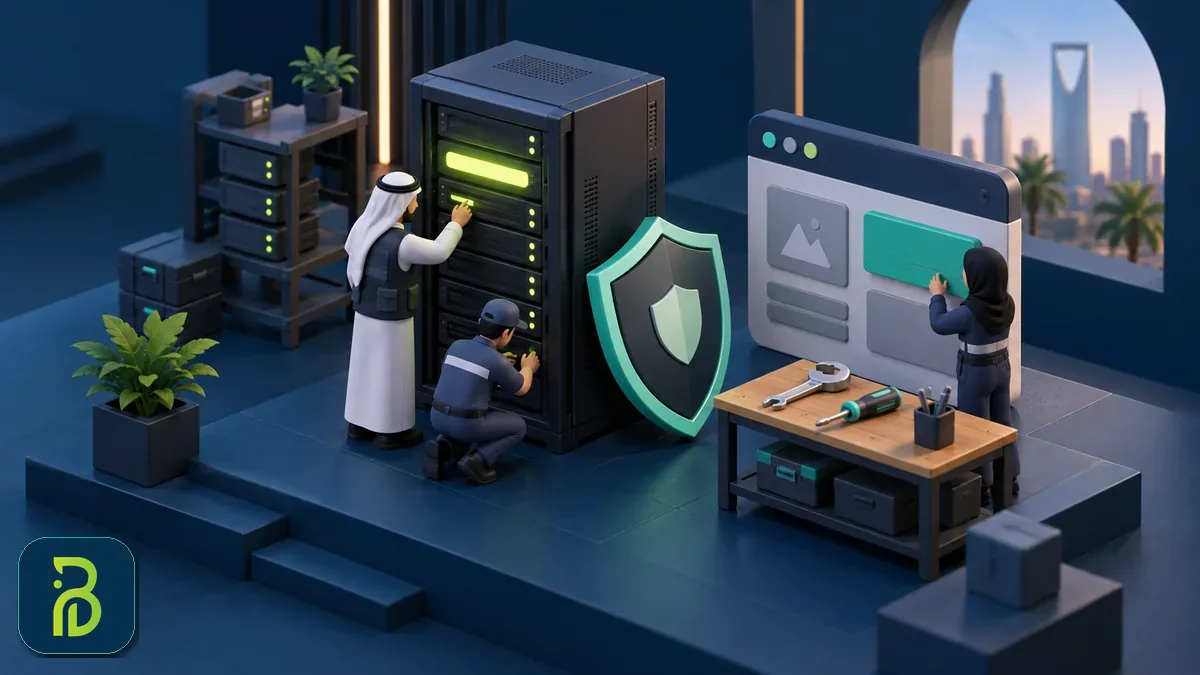
The cost of website maintenance in Saudi Arabia in 2026 ranges roughly from SAR 300 to 700 per month for a simple company profile website, SAR 700 to 1,800 for an advanced corporate website, and SAR 1,500 to 4,000 for an online store, excluding 15% VAT. The actual figure depends on three things: the type of website, how often maintenance is performed, and the response time written into the contract. If your company in Riyadh, Jeddah or Dammam has a live website or store that nobody updates, or its contract with the developer has ended, start with the matrix and the downtime loss formula below, then review the contract clauses before you sign.

Website maintenance is the ongoing work that keeps a website secure, fast and working as designed, months and years after launch day. A website is not a painting you hang on the wall and forget; it is software running on a server, relying on a programming language, a database, plugins and a security certificate, each with its own update cycle. When a provider tells you a package includes "maintenance", the right question is: which items exactly? Real maintenance consists of six areas:
The order matters here. Many companies pay for "edits" but never get a tested backup, and discover the gap on the day they need it. We covered the protection layers themselves in our website security guide for Saudi businesses; this article focuses on the contractual and financial side: how much you pay and what you get.
The most common confusion we see among clients is treating hosting as maintenance. Hosting is the "land" your website stands on: a server, storage and connection speed. The hosting company is responsible for keeping the server running, but not for keeping your website's plugins up to date or making sure your contact form actually sends messages. Website maintenance is the care of what is built on top of that land. Website technical support is the response when a problem or request comes up.
| Item | Hosting | Maintenance | Technical support |
|---|---|---|---|
| What does it cover? | Server, storage and network | The website itself: code, plugins and data | Resolving problems and requests as they arise |
| Nature | Fixed infrastructure | Scheduled preventive work | Reactive work on demand |
| Who usually provides it? | The hosting company | The developer or a maintenance company | The developer or a maintenance company |
| Example | The server is down | An outdated plugin with a known vulnerability | The payment button suddenly stopped working |
Some companies offer all three in one package, which is convenient as long as the items are clearly written down. And if your store runs on a hosted platform such as Salla or Zid, the platform handles the server, the core and the security certificate, and maintenance is limited to the theme, installed apps, content and system integrations, so it costs noticeably less than a WooCommerce store or a custom-built store.
There is no official market rate, but offers from Saudi companies generally range from a few hundred to a few thousand riyals per month. The following table summarizes the ranges we see in the market and what each tier should include. Prices are approximate as of 2026, vary with the website's size, technology and required response level, and are exclusive of 15% VAT.
| Package | Suits | Monthly price (SAR) | Annual price (SAR) | What it should include |
|---|---|---|---|---|
| Essential | A company profile website of up to about 20 pages | 300 – 700 | 3,000 – 7,000 | Monthly updates, weekly off-site backup, downtime monitoring, 1–2 hours of edits |
| Advanced | A corporate website with forms, an active blog and two languages | 700 – 1,800 | 7,000 – 18,000 | Weekly updates, daily backups, security scan, speed report, 3–6 hours of edits |
| Online stores | WooCommerce or a custom store with online payments | 1,500 – 4,000 | 15,000 – 40,000 | Daily or more frequent backups, payment testing after every update, response within hours, round-the-clock monitoring |
| Custom platforms | Custom-built portals and systems | From 3,000 | Often 15%–20% of the development cost | Updating libraries and the framework, bug fixes, reserved monthly development hours |
| On demand | Those who do not want a fixed contract | About SAR 150 – 400 per hour | No monitoring and no prevention; you pay only when something breaks | |
A quick rule for checking any offer: the annual cost of WordPress maintenance usually equals 10% to 20% of the cost of building the website, as we noted in our website design cost guide for Saudi Arabia. If an offer is far below that, ask what was left out; if it is far above, ask what was added. The technology also changes the math: a custom-coded website needs a developer who knows the code, so its maintenance costs more. We explained this difference with numbers in our comparison WordPress or custom development.
This matrix is the most important comparison tool here. Print it and place it next to any offer you receive, check that every item is mentioned, and that the stated frequency suits your type of website.
| Item | Company profile website | Advanced corporate website | online store |
|---|---|---|---|
| Downtime monitoring | Continuous (every 5 minutes) | Continuous | Continuous with instant alerts |
| Backups | Weekly | Daily | Daily for the database at least, and before every update |
| Backup restore test | Every quarter | Every two months | Monthly |
| Plugin and theme updates | Monthly | Weekly or every two weeks | Weekly, and immediately for critical vulnerabilities |
| Critical security updates | Within 48 hours | Within 24 hours | Within hours |
| File and malware scanning | Monthly | Weekly | Daily |
| Full test purchase | — | — | After every update, and at least once a week |
| Form checks and message delivery | Monthly | Weekly | Weekly |
| Speed review | Quarterly | Monthly | Monthly, and before peak seasons |
| User and permission review | Quarterly | Quarterly | Monthly |
| SSL and domain expiry tracking | Automated with alerts | Automated with alerts | Automated with alerts |
| PHP version review | Every six months | Every six months | Quarterly |
| Management report | Brief monthly report | Monthly | Monthly with downtime and response figures |
Note the "backup restore test" and "full test purchase" items. They are rarely mentioned in cheap offers, yet they are the difference between maintenance on paper and maintenance that actually protects you.

Does your website need ongoing maintenance and protection?
Request a free audit of your current website: updates, backups, security and speed, followed by a maintenance package with written terms and a clear response time.
Talk about maintenance stays theoretical until you put a number next to downtime. Use this simple formula and you will know how much prevention is worth for your store specifically:
Cost of one hour of downtime = (peak-day sales × peak hour's share of daily sales) + ad spend wasted during that hour + emergency repair cost
Let's apply it to a hypothetical perfume store in Riyadh:
| Item | Regular day (SAR) | Promotion day (SAR) |
|---|---|---|
| Sales lost in the peak hour (15%) | 1,500 | 4,500 |
| Ads sending traffic to a store that is down | About 200 | About 600 |
| Emergency repair | 900 | 900 |
| Direct loss for one hour | About 2,600 | About 6,000 |
In other words, one hour of downtime on a promotion day equals more than two months of a mid-range store maintenance package. And we have not counted what never shows up on the invoice: the customer who tried once and never came back, the negative review, and Google's declining trust in a website that goes down often. Replace the example figures with your store's numbers, and you will know the ceiling of what prevention is worth paying for.
A neglected website does not collapse in a single day; it erodes quietly and then fails at the worst possible moment. These are the most common consequences we see when we take over websites that have not been maintained for a while:
According to Patchstack's 2026 State of WordPress Security report, more than 11 thousand new vulnerabilities were discovered in the WordPress ecosystem during 2025, about 91% of them in plugins, and about 46% of them had no patch available at the time they were disclosed. The report also notes that mass exploitation attempts against the most targeted vulnerabilities begin within a few hours of disclosure. In practice, this means a website whose plugins are updated once every six months stays exposed most of the time, and that the core is usually not the problem; the plugins nobody reviews are.
Security support for PHP 8.1 ended on December 31, 2025, and support for version 8.2 ends on December 31, 2026, according to the supported versions table on the official PHP website. A website running on an end-of-life version receives no new security fixes, and many modern plugins stop supporting it. The upgrade itself is not a button you press; it can break an old plugin or a customized theme, so it needs a staging environment and a developer who reviews the result before it is applied to the live website.
The CA/Browser Forum, the body that sets the rules for security certificates, cut the maximum certificate validity from 398 days to 200 days starting March 15, 2026. It drops to 100 days in March 2027, then to 47 days in March 2029. Manual renewal once a year is no longer a practical option. If the certificate expires, your visitor sees a browser warning page instead of your store, and the payment gateway may stop accepting orders from a website without a valid secure connection. That is why maintenance must include automatic certificate renewal with an alert before it expires.
Payment gateways, shipping companies and the e-invoicing platform update their APIs and retire old versions after a grace period. A plugin that has not been updated can suddenly stop working. The same happens with the domain verification file that some digital wallets require, as we explained in our guide to enabling Apple Pay on your online store; if that file is deleted while the website is migrated or updated, the payment button silently disappears. That is why the "full test purchase" item is in the matrix.
Page revisions, old sessions and leftovers from deleted plugins pile up in the database, and oversized images get uploaded, so load time grows month after month. Slowness raises the bounce rate and weakens the website's performance in search engines. If you invest in ads or SEO through digital marketing, a slow website wastes part of that spend.
A service level agreement (SLA) is the part that turns the word "maintenance" into a commitment you can measure and hold the provider accountable for. You should find these clauses in writing, not just hear them verbally:
The National Cybersecurity Authority (NCA) issued the Essential Cybersecurity Controls (ECC-2:2024), which are mandatory mainly for government entities and their affiliates, and for private sector organizations that own, operate or host critical national infrastructure. If your company is a supplier to a government entity or operates a system on its behalf, ask about the control requirements imposed on you by contract, such as patch management, backups and event logs, and ask your maintenance provider to document its compliance with them. Even if you are not obligated, these controls are a good benchmark for judging how serious any maintenance offer is.
Each option has its place, and the decision depends on the size and sensitivity of your website:
A hesitant answer to the first question alone tells you that this provider's backups have never been tested.
Before anything else, make sure the login details for the domain, hosting, control panel and database are in your name and in your hands. Then ask the new provider for an initial audit that records the plugin, theme and PHP versions, the backup status and any suspicious files, before pricing the monthly package. This audit gives you an honest picture of your website's condition and prevents "cleanup" surprises after signing. And if it turns out the website is very old and needs rebuilding, it may be more economical in the medium term to rebuild it through our website design or e-commerce store development service, rather than patching a website that patching cannot fix.
At Bateel Tech Solutions, we start with every client by running this audit before making any offer, and we build the package on its results, not on a fixed price list. We have worked with websites and stores at different stages; some need light maintenance, and some need rescuing first.
Roughly SAR 300 to 700 per month for a company profile website, SAR 700 to 1,800 for an advanced website, and SAR 1,500 to 4,000 for WooCommerce stores, excluding 15% VAT. The real difference between offers lies in how often backups are made and tested, the response time, and the number of included edit hours.
Usually not. Hosting keeps the server and network running, but it does not update your website's plugins, test your contact form or checkout page, or fix code errors. Some companies sell hosting and maintenance in one package; in that case, the maintenance items must be written into the contract in detail, not assumed.
At least weekly for a company profile website, daily for an active corporate website, and daily or more often for an online store's database, with an extra backup before every update. Most importantly, backups should be stored off the server itself and their restoration tested regularly; an untested backup may fail on the day you need it.
Yes, but it is lighter and cheaper. The platform handles the server, the core and the security certificate, while you remain responsible for reviewing the theme and installed apps, testing payments and shipping, updating content and offers, and monitoring the store's integrations with other systems such as accounting. Many stores settle for a monthly hours package here instead of a full maintenance contract.
Yes, and it is the most common format for company profile and corporate websites: a fixed annual fee covering a set number of updates, backups, checks and edit hours, often at a discount compared with paying monthly. Just make sure the contract specifies what happens when you exceed the included hours, the rate for each additional hour, and what is explicitly excluded, such as a redesign or adding new features.
The website appears to keep working for a while, then problems pile up: plugins with known vulnerabilities, a PHP version without security support, growing slowness, and possibly an expired SSL certificate or a broken payment gateway integration. Fixing a hacked or downed website usually costs far more than a full year of preventive maintenance.
Website maintenance is not a cosmetic line item in the budget; it is what keeps your website or store running on promotion day, protects your customers' data and preserves your Google rankings. Start with three steps: make sure all accounts are in your name, apply the matrix above to your current setup, and calculate the cost of one hour of downtime with your store's numbers. Then you will know exactly which package you need and how much it is worth paying for it.
Our team at Bateel Tech Solutions in Riyadh takes over existing websites and stores, audits them, then offers a maintenance contract with clear terms, a written response time and a monthly report, whether your website runs on WordPress, WooCommerce or custom code. Contact us now via WhatsApp or through our Contact Us Page to get a free initial audit and a quote that fits your website.
