
Services
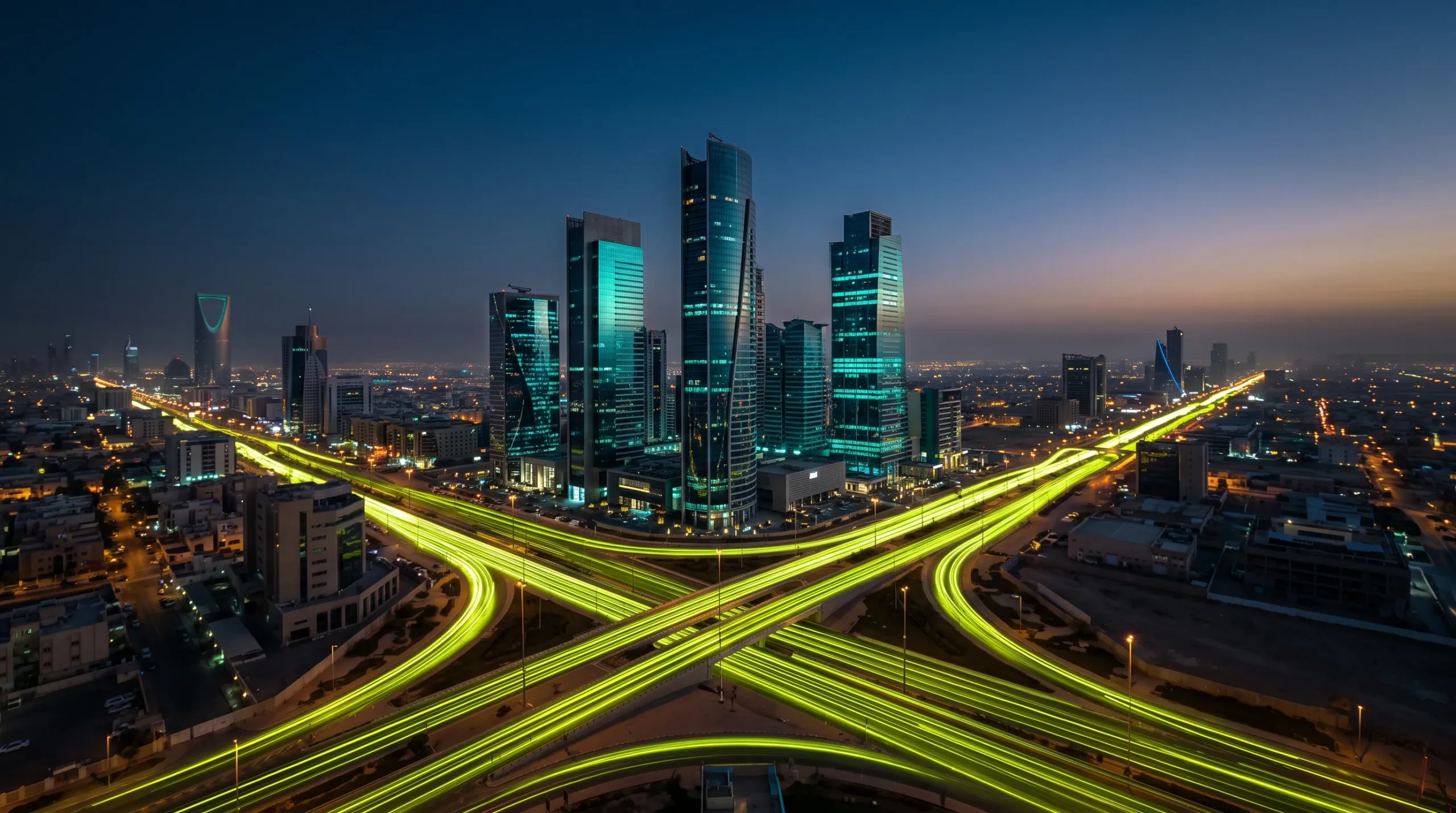

Digital transformation in Saudi Arabia is no longer a technical luxury or a project parked on the “later” list; it has become a basic condition for survival in a market changing at an unprecedented pace. Since the launch of Vision 2030, the Kingdom has become one of the most active digital economies in the region: internet penetration has exceeded 99%, electronic payments have become the Saudi consumer's first choice, and government entities have digitized almost all of their services through platforms such as Absher, Tawakkalna and Balady. In this landscape, a company that still runs its operations on paper and Excel sheets, and relies on walk-in customers instead of a digital presence, loses market share every day to better-prepared competitors. In this guide for business owners and decision makers, we explain what digital transformation means in practice, beyond the slogans, and how it connects to the Vision 2030 targets and the Saudi digital economy. We then present a realistic roadmap with phases and estimated costs in riyals, along with success metrics and the common mistakes to avoid, so you come away with a clear, actionable plan before we reach 2030.
Many business owners confuse three progressive concepts: digitization, which is converting paper information into electronic form, such as scanning invoices and saving them on a computer; digitalization, which is using digital tools to speed up an existing process, such as emailing invoices instead of printing them; and digital transformation, which goes much deeper: redesigning the business model itself (how you sell, how you serve your customers and how you make decisions) so that technology and data sit at the heart of the company, not on its margins.
Take a real example from the local market: a retail store in Riyadh that has an Instagram account and takes orders over WhatsApp has not yet transformed digitally; it has only “digitized” its communication channel. Real transformation happens when the store has an online sales platform connected to a real-time inventory system, electronic payments via mada and Apple Pay, an accounting system compliant with the Zakat, Tax and Customs Authority's e-invoicing, and a dashboard that shows the decision maker which products deliver the highest profit margin and which marketing channels bring the most loyal customers. At that point, decisions shift from “the merchant's gut feeling” to accurate data updated in real time.
Three factors make 2026 a critical point for Saudi companies that are lagging behind digitally:
When we talk about digital transformation and Vision 2030, we are not talking about a general slogan, but about a system of targets and government programs that have actually been implemented for years and are reshaping the business environment your company operates in. The Vision placed the Saudi digital economy at the core of the plan to diversify income away from oil, through three pillars that directly affect your company:
Today's regulatory and incentive environment favors companies that take the initiative to transform:
The strategic takeaway for decision makers: Vision 2030 does not only ask you to transform digitally as a national duty; it has built you infrastructure, a market and legislation that make the return on investment in digitization higher in Saudi Arabia than in most markets in the region. The government has digitized its services, consumers have embraced online shopping, and telecom networks are among the fastest in the world; in other words, everyone around your company has completed their transformation or gone a long way toward it. The question is no longer “should we transform?” but “in what order and with what budget do we start?”, and that is what the following sections answer in detail.
Digital transformation for companies rests on six integrated pillars. A company rarely needs to build them all at once, but understanding all of them is essential to prioritize wisely. Note that these pillars are not isolated islands; the power of digital transformation in Saudi Arabia comes from how they work together: the store feeds orders into the ERP system, the system feeds data into the analytics dashboards, analytics guide marketing, and marketing brings customers back into the store.
Your website is the only digital asset you fully own, unlike social media accounts that are subject to third-party algorithms and policies. A professional website in 2026 must load fast (in under 3 seconds), be fully mobile-friendly, be optimized for search engines, and be connected to analytics and conversion tracking tools. If your current website is just an old “online brochure”, or you do not have a website at all, this is your starting point. Explore Bateel's web design service to build a digital presence that works like a sales employee who never sleeps.
If you sell products, an online store is no longer an extra channel but a main one; Saudi consumers are among the most active online shoppers in the region. Options range from local cloud platforms such as Salla and Zid to open solutions such as WooCommerce, which give you full ownership and control. Each option has its ideal use case, and we have covered the full comparison in our article Salla, Zid or WooCommerce: which is best for your store?. Our team can build your store from scratch through our e-commerce store development service, integrated with Saudi shipping companies and payment gateways.
An app is not a necessity for every company, but it becomes a worthwhile investment when you have repeat customers (restaurants, salons, delivery, clinics, subscription services) or field operations that need real-time management. The decisive advantage of an app is push notifications that reach customers directly without going through ad algorithms, which increases repeat purchases and lowers retargeting costs. Learn when and how to build your app in our mobile app development service.
Once your company passes a certain stage, scattered Excel sheets and WhatsApp groups become a burden that creates errors, duplication and lost information. An enterprise resource planning (ERP) system unifies accounting, inventory, sales, purchasing and human resources on one platform with real-time data, and ensures compliance with e-invoicing. Odoo in particular has become the most widely adopted choice among Saudi SMEs because of its flexibility and reasonable cost compared with large global systems. See our comprehensive guide Odoo ERP for Saudi companies for details on modules, costs and implementation.
AI is no longer reserved for giant corporations. Today, a small business can deploy a chatbot that answers customer inquiries around the clock, content generation tools that cut hours of marketing work, and predictive analytics that forecast demand and improve inventory management. The Kingdom itself is betting heavily on this sector through the Saudi Data & AI Authority (SDAIA) and major investments in projects such as “HUMAIN”, which makes early AI adoption a competitive advantage aligned with the direction of the whole country. The golden rule: start with one specific use case that solves a real problem, such as customer service, then expand.
All the previous pillars are infrastructure; digital marketing is what brings customers into them. An effective mix for Saudi companies combines search engine optimization (SEO) as a long-term, compounding investment that brings customers with clear purchase intent, paid ads on Google, Snapchat and TikTok for fast results, and visual content and motion graphics to build brand trust. The right balance between these channels depends on your sector and your customers' buying cycle, and that is exactly what we design for our clients through Bateel's digital marketing service.
Ready to start your company's digital transformation?
Bateel is your local partner, from websites and online stores to ERP systems and AI.
The biggest mistake decision makers make is trying to do everything at once or, at the other extreme, postponing everything while waiting for the ”perfect budget”. The right way is to progress in phases, where each phase builds on the one before it and generates a return that funds the next. Here is a realistic roadmap tested in the Saudi market:
| Stage | Estimated duration | Key steps | Estimated cost (SAR) |
|---|---|---|---|
| 1. Digital foundation | 4 – 8 weeks | A professional mobile-friendly website + a Google Business Profile + a consistent identity across social platforms + official email on the company domain | 8,000 – 25,000 |
| 2. Activating digital sales | 6 – 12 weeks | An online store connected to payment gateways and shipping + basic SEO setup + test ad campaigns to gauge the market | 15,000 – 60,000 |
| 3. Digitizing internal operations | 2 – 4 months | An ERP system (usually Odoo) for accounting, inventory and sales + full e-invoicing compliance + team training | 30,000 – 120,000 |
| 4. Expansion and excellence | 3 – 6 months | A customer mobile app + marketing automation and AI chatbots + analytics dashboards for decision making | 60,000 – 250,000+ |
Important notes on these figures: first, they are estimated ranges that depend on the size of your company and the complexity of your operations; a service company with ten employees is not a factory with three hundred. Second, you do not have to complete all four phases; many small businesses achieve a real leap with the first and second phases alone, with a total budget starting at around SAR 25 thousand. Third, spread the investment over time: set aside a monthly budget for marketing and operations instead of spending the entire budget on building and then leaving your digital assets without fuel.
The success of digital transformation projects in Saudi Arabia depends on the implementation partner as much as on the plan itself. When evaluating any technology company, ask about four things: documented past work specifically in the Saudi market (because e-invoicing requirements, local payment gateways and Saudi consumer behavior differ from any other market); the partner's ability to cover more than one pillar, so your systems integrate instead of fragmenting; a clear contract that puts ownership of the website, code and data in your company's name, not the vendor's; and finally, technical support and maintenance after launch, because a digital asset without maintenance erodes like any other asset. The right partner does not sell you the biggest possible project; they set your priorities and sometimes convince you to postpone what you do not need right now.
What is not measured cannot be managed. The fundamental difference between a company that “spent on technology” and a company that “transformed digitally” is that the second knows, in numbers, what every riyal it invested has achieved. Before launching any phase, set clear digital KPIs and compare them monthly with the baseline before the transformation:
The practical rule: review these metrics in a fixed monthly meeting, and give every digital initiative at least 90 days before judging it, with one exception: paid ads, whose trends can be assessed weekly. If your company is just starting out, three metrics are enough: website visitors, the number of leads (calls, WhatsApp, contact form) and customer acquisition cost. Simple measurement is better than a complex dashboard that nobody opens.
Here we summarize what we have seen in the field with dozens of Saudi companies: the mistakes that turn digital investment into wasted cost:
The good news is that all these mistakes can be avoided with simple advance planning: define the problem before the tool, involve your team from day one, work with one integrated partner, set aside an ongoing operating budget, and appoint a project owner from senior management. With these five rules, your digital project's chances of success rise significantly, whatever the size or sector of your business.
The cost of digital transformation in Saudi Arabia varies with the project scope: the foundation phase (a professional website + a presence on Google and social platforms) starts at around SAR 8,000 – 25,000, and a small business can reach full online selling with a total budget of SAR 25,000 to 60,000. Integrated solutions that include ERP and a mobile app exceed SAR 100,000. More important than the figure is a phased approach: start with what delivers a direct return, then reinvest that return in the following phases.
Start with an honest assessment of where you stand: do customers find you when they search on Google? Can they buy from you or book with you online? How many hours does your team spend on manual work that could be automated? Then build the foundation (a professional website and a Google Business Profile) before any other investment, because every other channel feeds into it.
Some of its components have already become mandatory, above all e-invoicing (FATOORA), which the Zakat, Tax and Customs Authority is rolling out in phases, and dealing digitally with most government entities. The other components are not legally mandatory, but the market makes them mandatory: Saudi customers buy from businesses they can find and trust online.
The core infrastructure (website + store + marketing presence) is usually completed within 3 – 6 months, and digitizing internal operations with an ERP system needs another 2 – 4 months depending on complexity. But digital transformation is by nature an ongoing journey, not a project that ends; after building comes the phase of continuous data-driven improvement, which is what creates a real competitive edge.
Yes. “Monsha'at” offers support, financing and training programs for SMEs, banks and finance companies provide products dedicated to financing technology, and there are sector initiatives such as e-commerce programs and support for cloud solutions. Check your business's eligibility for these programs before you start, as they may cover a significant part of the cost.
Vision 2030 has built the highway; the decision to get on it is yours. Companies that start digital transformation in Saudi Arabia today, even with one well-planned step, will be in a completely different negotiating and competitive position by 2030, while latecomers will pay double to catch up.
At Bateel Tech Solutions, we cover all the pillars of digital transformation under one roof in Riyadh: web design, online stores, mobile apps, Odoo ERP systems, AI solutions and digital marketing, with integrated solutions that talk to each other and save you the hassle of coordinating multiple vendors. We start with a free assessment session of your current digital position and give you a prioritized roadmap with a budget that fits the size of your business.
Contact us now on WhatsApp at wa.me/966537272445 or via Contact Us Page — and make 2026 the year your company takes off digitally.
